 |
| Balloons! |
 |
| A nifty lucite model of the Valley and its tombs |
If we thought 8:30 a.m. was a difficult start time, that was nothing! This morning, we had to be ready for a 6 a.m. departure. Destination? Valley of the Kings!
The Valley of the Kings is a complex of underground, hidden tombs. The tradition started when one of the brighter pharaohs realized that building a giant pyramid is equivalent to a flashing neon sign saying, “Riches within! Come rob me!” Since obviously the grave goods were an important aspect of their ability to make it in the afterlife, security was essential.
 |
| The upper surface of the model. The flags are known tomb entrances. |
 |
| Horus, life-sized |

 Robbers are an enterprising lot, though, and were not hugely deterred. Eventually, all (?) were found except for Tut Ankh Amun’s grave (known in the Western world as Tutenkhamen), which was found essentially by chance by explorer Howard Carter in the early 1900s. While the world was astounded by the opulence of the grave goods, it turns out that Tut was not actually a particularly important king in his own time. According to our tour guide, many of his grave goods were not originally intended for him but rather for some other noble; his untimely death (by malaria) threw all into confusion and pretty much anything they could lay their hands on was chucked in there for luck.
We had already seen the grave goods, and his tomb wasn’t open for visiting (although we saw the entrance to it). However, we had the chance to visit five other tombs. These included an extra-special tomb of Seti I. This tomb has only been open for visitors since last year; prior to that, it had been 11 years since visitors were allowed. The authority rather cleverly limits the tombs that are open, because it gives each one a rest from the humidity influx, but it also means that visitors have something new to see if they come back on repeated visits!
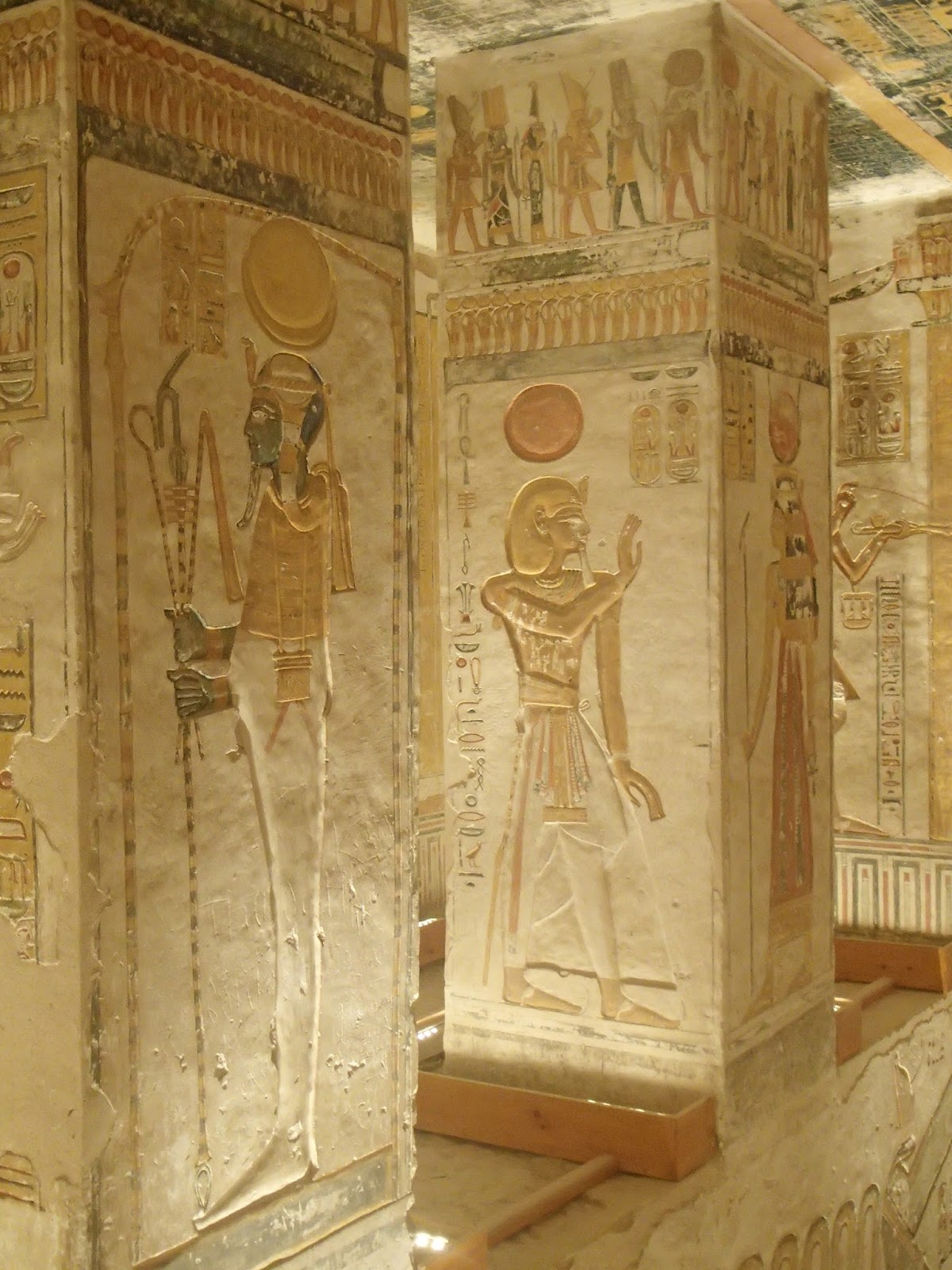
We weren’t allowed to photograph Seti’s tomb, but these other shots should give an indication. The scale of the plaster images, the freshness of the colors, and the sheer artistry were astounding. Having seen some of these in my art history classes was little preparation for the overall effect. Yet another lesson that there is no substitute for visiting a place! The difference in climatic conditions is striking in the preservation of plaster decorative works: a 13th-century fresco in Europe is liable to be fragmentary at best due to moisture damage; by contrast, these tombs (over 4 millennia older!) were nearly pristine save damage due to vandals. We deduced that the walls had been plastered and then a cartoon drawn on top. The plaster was then carved away to form bas-relief images and impressions that were colored later.


 |
| The amount of detail is staggering |

 |
| Yes, they have a Book of the Holy Cow |

 |
| Michael liked the rowing eye of Horus |

 |
| I thought these grasshopper women were really interesting |

 |
| These figures were life-sized |

 |
| Ceremonial boat |
 |
| This was about 3 meters long/tall |


It was then time to visit the Valley of the Queens, a short drive away. This valley is smaller, and contained not only queens, but also children of pharaohs. Unsurprisingly, given the high rates of incest, the child and infant mortality rate in the Egyptian royal family was extremely elevated. One such tomb (located in the Valley of Kings and not open for visiting) held something like 70 of Ramses’s children.
A tomb we visited had been repurposed as a Coptic Christian meeting house, then later burial site. At one point, animals had been kept within its walls. Samar commented ruefully on its poor state of preservation, but even this “poor” preservation was remarkably intact. Interestingly and sadly, there was some graffiti, though.
The showstopper here was Nefertari’s tomb. Discovered by Italian explorers in 1904, it is richly decorated throughout. For preservation purposes, we were only allowed to visit for 10 minutes, but we were agape the entire time.
 |
| Coptic Christian graffiti |

 |
| I loved the brickwork |
A drive-by visit of the Colossei of Agamemnon (which had nothing to do with Agamemnon, but were rather sculptures of Amenhotep, Tut’s father), and time for the hotel!
 |
| Loved the decoration on this building |
 |
| Many houses are built with preparations for a second story. As money becomes available, partial walls are built. Eventually the story may be completed, either for the family or for an adult (married) child. |
 |
| You can just see the roofing material: reeds |
 |
| There were lots of donkey-drawn carts. The donkeys here are tiny! |


Quick lunch, then relaxation for the rest of the afternoon. As I write this, I am sitting looking at the Nile river with cool hibiscus tea.
Love,
Alexandra


