Saturday, October 13, 2018

Grotte di Castellano and Tranni

Our last day in Puglia was marked by delightful weather: ironic, given that this was the day we would spend "inside" ... in the caves, that is!

The Grotte di Castellano are remarkable for their depth, the size of their chambers, and the "White Cave," which is a stunning collection of white crystalline stalagmites and stalagtites and other accretions. Sadly, we weren't allowed to take photos, so you'll have to take my word for it or go there yourselves.
Before we made it to the grotte, we could have gone to a planetarium show: FIFTY SEATS!


From the bottom of the cavern, major zoom

At lunch, there was a hilarious interplay between the dog
 (leg casted, so limping) and the cat (totally not impressed with the dog)

Did I mention our bus has an external coffee set-up?
After lunch, the main goal was to make it back to Umbria. However, we couldn't resist a very quick stop in Tranni, which had the lovely sight of its cathedral perched on a peninsula and apparently surrounded by blue waters.

Tranni


13th-century fortress in Tranni


A wonderful trip finished!

Love,

Alexandra

Lecce, Otranto, and Santa Maria di Leuca

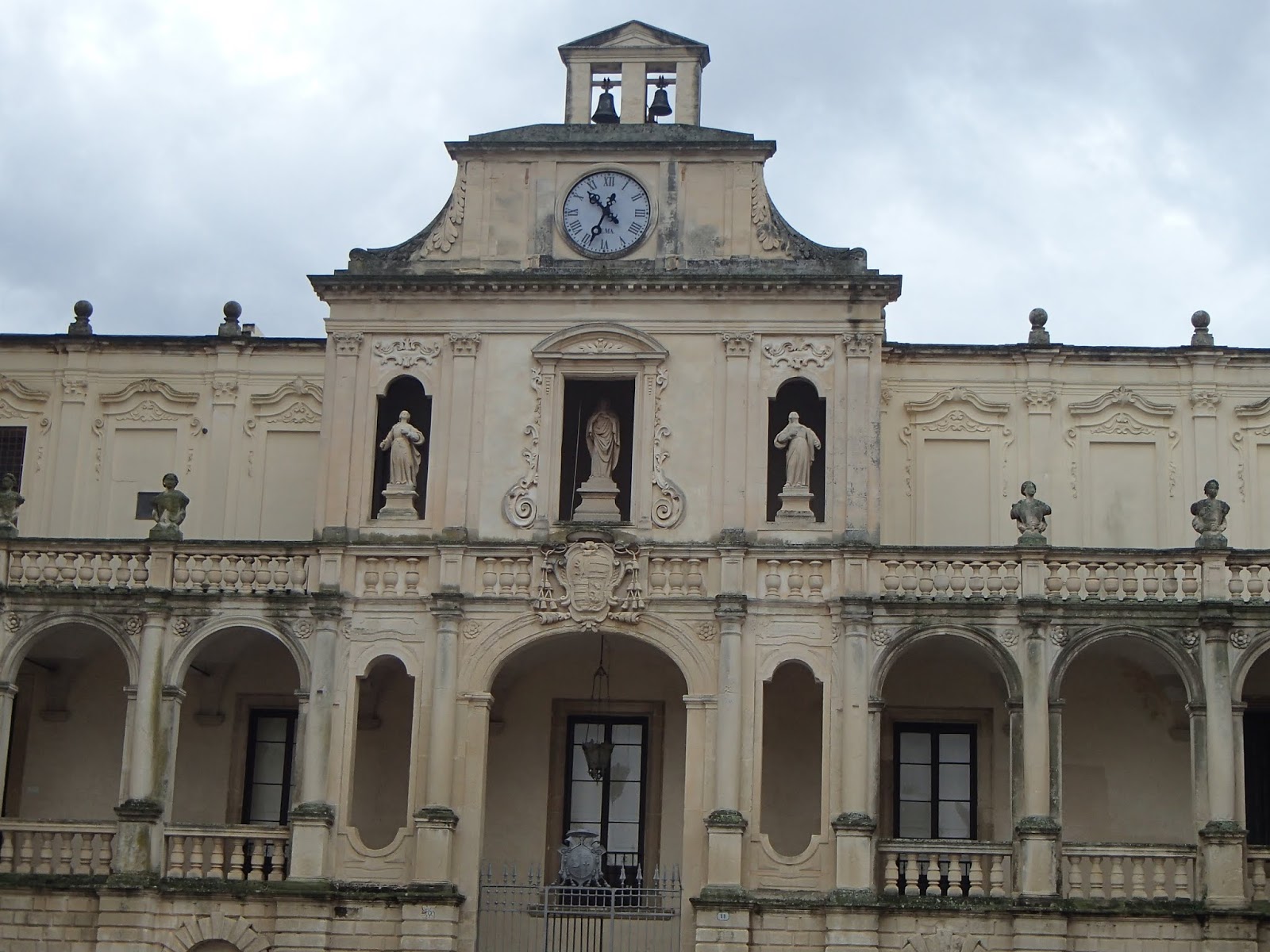
Lecce (pronounced "LEH-cheh") is an ancient port city on trade routes between the Ottoman Empire and pretty much everywhere else. So of course it has a very long history! We had the non-delight of visiting it under a rather heavy downpour, so it wasn't worth taking a lot of photos. It seems that in Lecce, you either get to see a little of ancient Rome (in the form of a theatre and some stretches of pavement) or a lot of Baroque. There didn't seem to be much in between. 

In my view, a little Baroque goes a long way. Beautiful craftsmanship, stunning colors, but...very stimulating from the visual standpoint, without a doubt.


Having exhausted our available time there, it was time to move to Otranto. Otranto is famous for a raid by the Turks, wherein 800 of the town's boys were slaughtered wholesale. It's a delightful, though small, town, and I was fascinated by the "torre matta" ("crazy tower") where the original 15th-century rounded ramparts were later enclosed in 16th-century rectangular fortifications.

This looked like a ball of fur with five heads: cat hydra!
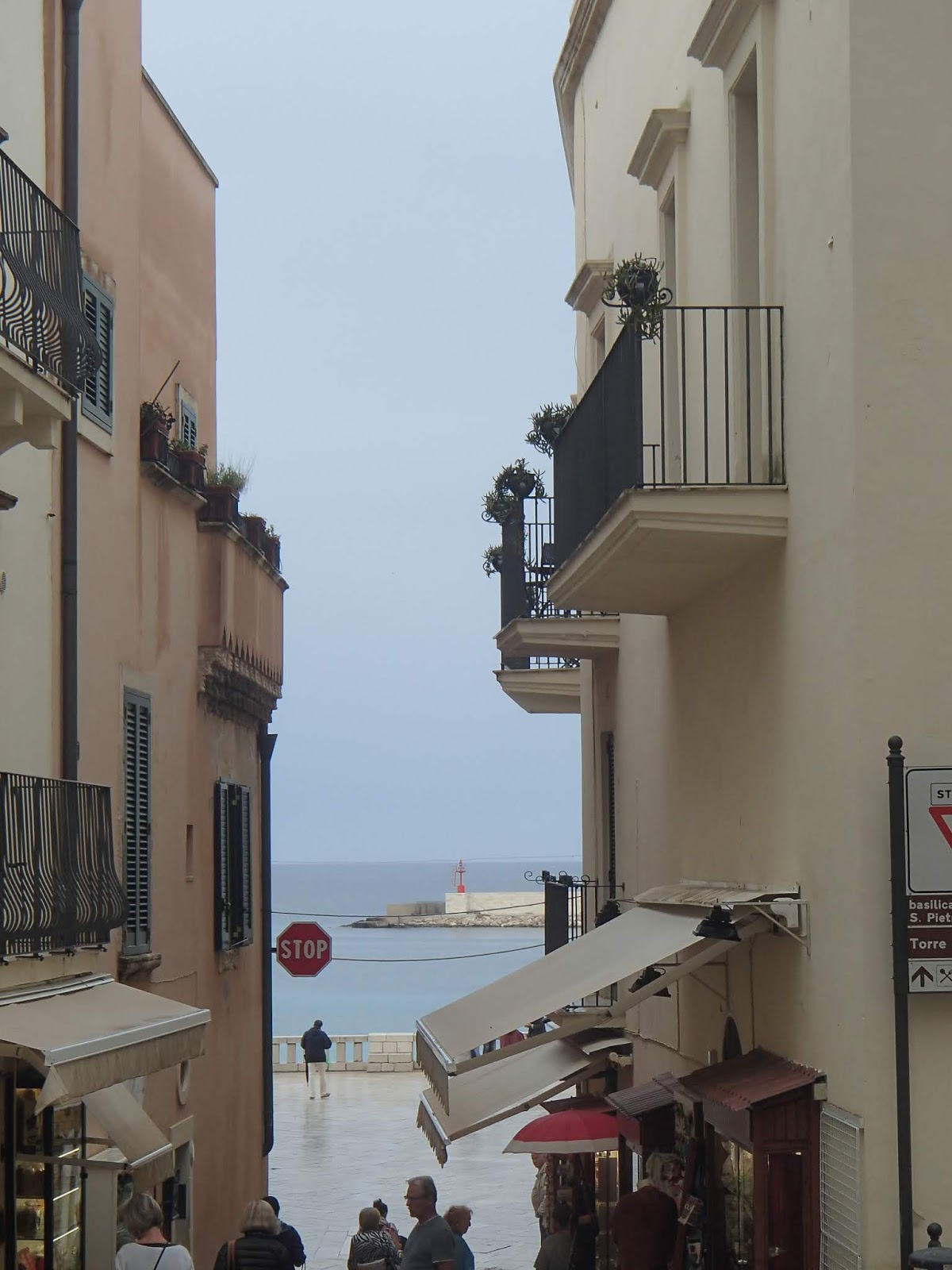
View into the port area

And then it was a race to get to the furthest point on the heel before sunset. Although sunset won, it was a lovely overlook. Apparently, the line where the Ionian and Adriatic Seas meet is actually visible due to a slightly different water composition and the wave ridges that meet in a distinct pattern; of course, this takes bright light, which obviously wasn't available during our time there.


Iconic lighthouse, second most important in Italy

The port area below

Tired, hungry, but satisfied, we returned to the hotel for a late dinner.

Love,

Alexandra


Zoning Out

When I visited the planning office during the days of choosing our geometra, I saw an intriguing map on the wall:

Zoning map. San Fortunato in blue, our building in red


While I could easily tell that these were the buildings of Todi's downtown area, I was of course curious about what it meant, since different structures were depicted in different colors. Upon asking for clarification, the zoning officer casually said, "Oh, that's the map of relative ages of the buildings. The lighter beige are the older buildings. You can see that your home is the newcomer of your neighborhood; it was built in the same time classification as San Fortunato."

Yes, San Fortunato was built between 1198 and 1590. Ish.

This is a small portion
 of a very famous map of Todi
 from the 1600s.
At that point, our house is only 2 stories
The third story dates to 1700s/1800s.
Love,

Alexandra

Preconstruction

In Italy, if you want to work on your house (particularly on the exterior), you must have permits. Some are local (comune level) and others have to go to the Sovraintendenza in Perugia. There are different ways of dealing with it, but most people hire what is called a "geometra" (it's a profession that doesn't exist in the US, but imagine a general contractor who doesn't actually have any employees. He or she will plan the project/create the detailed design drawings/figure out which sections need a structural engineer or other specialty work/subcontract out the specialty work and manage the site construction workers/manage site safety/request permits/and so on and you're close). The geometra has a very important role and can determine whether or not you finish your project in a decent, timely manner or at all.

Since we wanted the boys to have a chance to live in this house before they left the family for greener pastures, speed is of the essence. The good news? We would be allowed to apply for permits under the current owner's name that would then transfer to us upon sale of the house. The bad news? Some of what we want to do requires Sovraintendenza permission, which could take three months.

A good geometra was definitely top of mind.

One of the two builders we wanted to use recommended one geometra. A friend who's a real estate agent recommended another. We got bids from both, just as a comparison. That said, neither of my builders really liked the second option, which gave me pause. The bids came in: the first was nearly TWICE the cost of the second. Gah! Time for a third proposal (meanwhile, the clock's ticking, because we really need to define the work and apply for those permits!), so we asked the geometra who currently works at the property (good reputation, knows the property, may even have drawings that could save us time and money), and then for good measure got a proposal from the geometra my second builder recommends. Now we have FOUR proposals to read through and understand. Of course, the first two were reasonably discardable.

My impressions of the last two were that the current geometra, while honest and friendly, seemed to tell me why I couldn't get things done quickly. The fourth, meanwhile, explained the obstacles and then told me how he'd get around them. These last two had costs that were about those offered by the cheaper of the first two proposals, so the money looked okay.

I went to the comune planning office, where of course the permitting officer couldn't tell me a thing legitimately. But he praised my ability to judge character when I described my impressions.

So: Luca Orlandi was my choice! I hired him on Monday, had a signed contract on Wednesday, and left town on Thursday (having told him what our general ideas were for the house construction). I arrived back on Monday, and he called me on Tuesday having taken detailed measurements of the house and all its rooms, and having developed a few different ideas for doing the construction to meet our needs. The crunch was to figure out which pieces need to go to the structural engineer so that he could work on the calculations while Luca was gone on vacation. That would keep the project going even during the summer break, and would keep us on track. Have I said that I love Luca yet? Because I do. He really reminds me of Michael and Michael's practical approach to the work. He's very flexible about meeting locations (he's not walking distance), and he's been so responsive; every time I think of calling him, he manages to call me first.

We're in mid-August now (Ferragosto, to be specific) as I'm writing this, and the plans are nearing completion for permitting. So exciting!

Love,

Alexandra

p.s.  We got word earlier this week that the permits that go to the Sovrintendenza have already been issued! We're ready to go on the major sections!

Moving Money

I briefly alluded to money woes in a different blog. Here's the deal: thanks to the US's crackdown on illegitimate money movements, those of us who have perfectly innocent intentions also have difficulties. Add to that some little cultural issues, and you have a recipe for disaster. For a while, when we were trying to get our money across the pond, we felt like we were in a Tilt-a-Whirl ride in some demonic financial amusement park.

We had money available in the US. We had a few options:

1. Write a check that the Italian bank would definitely take weeks to cash (past experience) and where there would be hefty fees.
2. Use a money transfer service, which could charge substantial fees or not, depending on whom you asked and which service you used. This would require setting up an account for approval, which could take days for a US Person.
3. Open an American bank account that could handle international wire transfers (ours didn't, but our brokerage account did...but these accounts were our IRAs and couldn't be touched, so we'd have to send money from a trust account that had no money in it to speak of). This could also take days (or weeks, depending on whether they needed original signatures on forms that would have to be mailed). This also involved either using the existing account I had (whose exchange rates and customer service I don't love)
4. Open an Italian bank account that had an American presence (non-existent, but worth a shot).

We basically tried to do the middle two simultaneously. Michael was in charge of the money transfer service (spoiler alert: in the short term, his method won. In the long term, it's the more expensive choice so we still wanted to try for option 3) and I was in charge of opening the alternative Italian bank account.

I went in person to talk to different banks, and I settled on Fineco ("la banca che simplifica la banca"/"the bank that simplifies banking" is their slogan) because they would let us have multiple currencies at once, they have great exchange terms, and I had simultaneously been trying to figure out how to deal with Florence's payments in pounds sterling...so it would solve an additional problem.

Well. It has a really easy process for setting up the account: you print out an online form, sign it, include your W-9s, copies of your documents, and send a wire transfer from your existing Italian bank account OR alternatively go to a branch office (ours was inconveniently 45 minutes away, in Perugia) for them to identify you. I blithely paid for the express (supposedly overnight) service at the post office, sent all the documents, requested the wire transfer, and waited. And waited. And waited. After multiple days, I got an email saying "Anomalia" ("anomaly") and telling me that I had a problem because the name on my new account ("Alexandra Hook") didn't match the name on my wire transfer ("Alexandra Claire Hook"). Oh, and fun fact: my W-9 has "Alexandra D. Hook" (maiden name initial), my American passport has "Alexandra de Kok Hook," and my British passport has "Alexandra Claire Hook." Fineco had kittens about that, but I fortunately found a document put out by the British Consulate composed in Italian for just such an eventuality that said that English speakers just don't really get hung up on names and have a lot of flexibility, and that when we do business in Italy, they will just have to get over it.

This was just the beginning of a series of disasters with Fineco that finally ended in August (two months later) with the opening of my account. They proceeded to find every way to make my life complicated, but I persisted solely for the purpose of having the multiple currencies and the decent exchange rates. We have now successfully received money from the US using "normal" banking channels (wire transfers) rather than money transfer services.

In the meantime, after a week of seriously high stress (we were worried that the earnest money wouldn't come in time, and the contract would be nullified), the money came across with a wire transfer service, so we were locked in!

If you ever want to bank in Italy, pay attention to the name you use.

Love,

Alexandra de Kok
Alexandra Claire de Kok
Alexandra de Kok Hook
Alexandra Hook
Alexandra D. Hook
Alexandra C. Hook
Alexandra C. de Kok


A Fresh Start...and a New Experience

We have had something in the works behind the scenes for a few months, but we can finally let others into the loop: we've bought a house here! There is a lot to report, since there has been a lot going on in various directions. There has been a lot of bureaucracy and some differences that you might find interesting (or frustrating at second hand!).

To give an overview of how we found the house: since we were in the process of selling the Atlanta house, and our remaining personal effects were being shipped over to the tiny space we are now occupying, space was a consideration. Combine that with:

1. Our desire to have a home rather than a vanilla rental with low-quality furnishings;
2. A slightly better euro-dollar exchange rate compared to when we arrived;
3. A greatly depressed real-estate market here in Todi;
4. A greatly inflated real-estate market in Atlanta;
5. A minimum of 2 more years here living actively;
6. Low real-estate carrying costs here

and you have the formula for Househunters International, Hook Version. We traipsed around with various real-estate agents who showed us their offerings.

A note about the real estate market here. While some houses have been renovated and are photo-shoot-ready, many of the houses appear to have been left as they were the day Granny moved to the old folks' home, complete with items in the fridge, in one place used Q-tips on the edge of the tub, and so on. Curb appeal isn't something that really comes into things here, somehow.

We'd seen a lot of houses, and I tracked down the owner of my dream house (one I've loved since the first time we came to Todi; it sold in December 2012, and had had some work done on it. Subsequently, there hadn't been any more progress or action visible for years) using a combination of local intel and (incredibly) a paid private eye. He was mildly interested in receiving an offer, but upon learning exactly how bad an investment he'd made (it was an investment house, not one he wanted to live in), he expressed dismay and a desire to have time to consider the situation.

We were in agonies, because this house has everything you can imagine in a charming Italian house! However, we had received a call from an agent for an appointment on a Friday afternoon; prior to going to look at his property, Michael and I discussed what it would take to increase our offer for the dream house. We both stated that we were open to seeing this newly-listed property, and we would then make a decision on our offer.

As we walked through this new property, we just couldn't even look at each other. While it's not my dream house by a long chalk, the price was a THIRD of what the other fellow really wanted to get; in so many ways, it is absolutely perfect! Part of a larger palazzo, this property is what's called a cielo-terra (sky-ground), meaning (roughly) similar to a townhouse. Except, of course, that these are buildings dating to the 1400s and earlier in some cases, and they have been subdivided over the years in very peculiar ways. An American townhouse would be a uniform column; Italian cielo-terras, on the other hand, are more like a Jenga structure: some floors are larger than others, and share a roof with someone else's apartment or possibly may host someone else's apartment under the roof profile.

In general, a cielo-terra is the most valuable type or property because you're not walking over people's heads, nor are they walking on yours. You also have more possibilities for renovation, since the plumbing and wiring access are available to you between floors.

Apart from the fact that it's a cielo-terra, it offers a large-enough entry hall, a first-floor that is great for "day use" (living room/dining room/kitchen plus powder room and guest suite possibilities), and an amazing "night zone" (three bedrooms, two of which are enormous, one bathroom, a kitchen that can be converted to a bathroom, and then a walk-through study/library). There is a terrace off the master bedroom, and an exterior stairway to the attic, which is large enough to offer considerable storage and the possibility of conversion to an office.

After having inquired three times about the price, we left the agent just in front of our current front door (about 100 m from the palazzo we'd just left). We looked at each other, and were of one mind: make an offer before someone else snapped it up. Next step: find the real estate agent again! He was lurking in his little kiosk, and looked mildly surprised, but happily took down our details. We were perfectly prepared to offer the asking price, but he suggested we knock a bit off; we took all of his suggestions and crossed our fingers!

The next morning, it was under contract to us! However, before it was really under contract, we had to transfer the earnest money (a full third of the contract price, by the way) from the US. That was an adventure to be described in a different blog.

And now began the waiting period: there were currently renters in the space, so we would have to wait to close until they departed September 30. Because of the long wait (this was in July!), our agent recommended that we file the purchase agreement in the Comune. This meant meeting the sellers for contemporaneous signatures of an official, customized document rather than just having signed copies of the preprinted-and-hand-filled-in forms that can serve as an official offer when closing is imminent.

The owners were representatives of a family trust, and seemed really kind. They have a great reputation in town, and they were very patient as we went through the stipulations and made sure we understood everything. As you'd expect, the exact sections of the exact structure of the exact plat were delineated. We signed, put on the "marche da bollo" (remember stamp taxes you learned about in history classes? These are alive and well here. To get a "marca da bollo" you go to your local tobacconist's and get one. These were 16 euros for every 100 lines of writing on the contract plus 2 euros for every addendum page (the plat drawings). This is also the origin of the expression "papal bull"), and shared smiles all around.

And that's when it came out. One of the owners casually said, "Oh, and there's a basement room that can't be separated or sold separately from the property, so you can have it for free as part of the purchase if you want it. Only thing is, there's a heating oil tank in it that you'll have to remove. It will probably have to be specially treated to be removed in pieces, because it was built in that room. It's too large to go through the doors." With my background in property condition surveys, I of course go into a panic and think, "Abort, abort, abort!" but I try to stay calm and cool and find out more information.

That's a story for another blog post. But the short answer is, I know the person who put in the oil tank in 1993; methane arrived into centro in 1995, so the tank was in use for only two years. I've looked at it, and there is no apparent leaking (nor would we expect there to be, knowing the person who built it), and they can pull it out without too much disruption to our lives.

In the meantime, we also discovered that in fact, it's not the space the owners thought it was...and they COULD sell it separately. So we've been trying to find out whether they'll honor the offer of the space, given that the classification is not what they thought it was.

And there you have it! Phase One of the Hook Househunting Huzzah.

Love,

Alexandra

Tuesday, October 9, 2018

Martina Franca and Ostuni: candid reflections

Bear in mind that we had lousy weather for the entire trip, so of course we were limited in our observations and our ability to photograph. Continuing onwards, we visited Martinafranca for lunch, and Otranto in the afternoon. Martina Franca is one of the largest towns in the area, and offers a splendid opportunity to get lost. Seeing the sights was made more difficult by the fact that the helpful signs pointing the way to monuments disappeared, leaving you hopelessly disoriented. On the other hand, once I'd given up seeing anything "noteworthy," I had a splendid time just wandering around. The buildings are white, as are the streets. I could easily imagine their brightness on a sunny day. 

This archway had a shrine, and was the entryway to several houses


The steps to someone's residence were quite steep!

You saw occasional glimpses of ballerina pink, for some reason.
Once everyone was sated, it was time to move on to Ostuni, the "white city." Again, charming winding streets, enchanting entryways, and lovely views. This town also has a horseshoe shape around a valley.


Intriguingly, this dome had colored tiles.


Back in the bus, and time to move on to Lecce!

Love,

Alexandra